
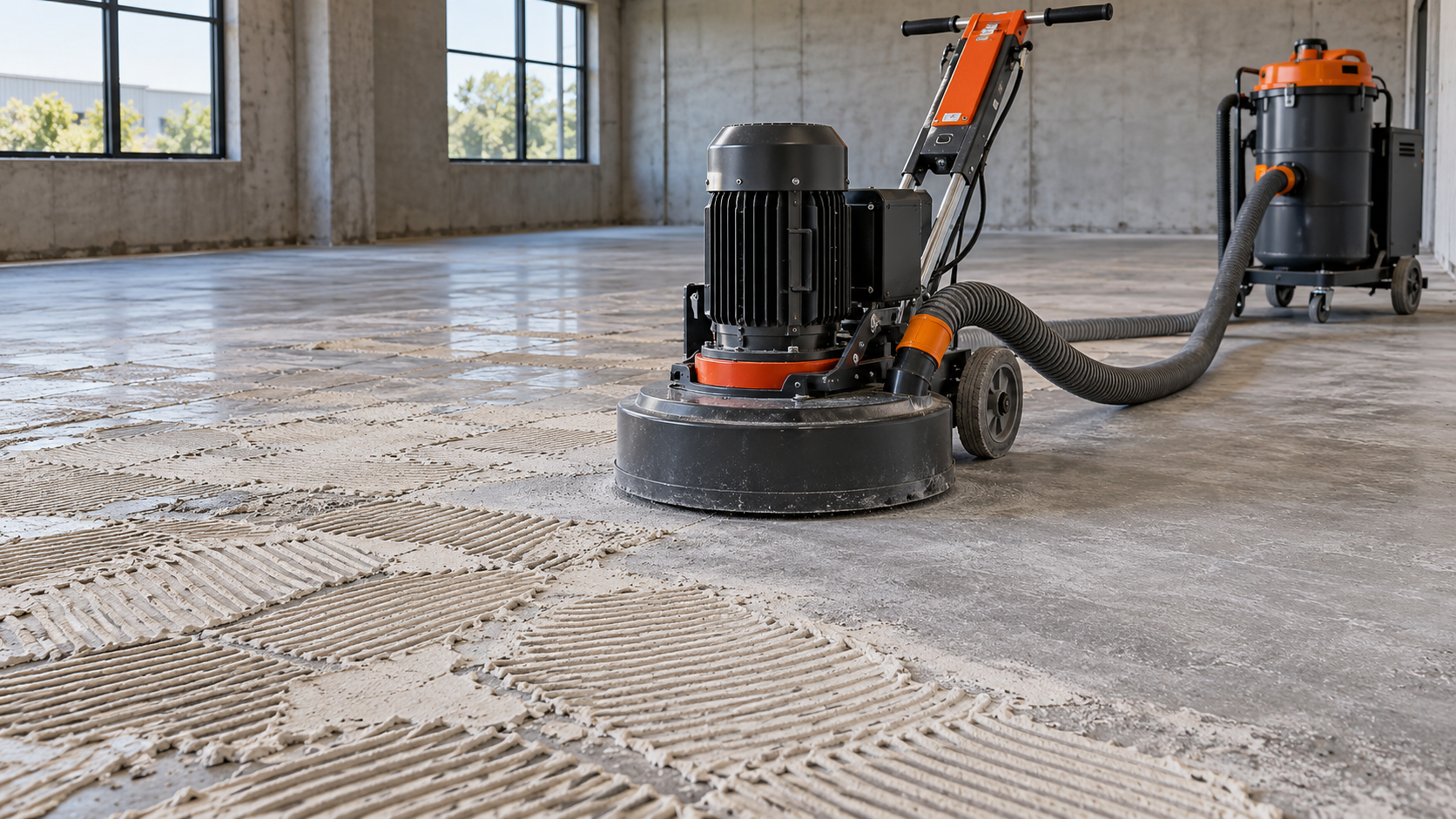
Concrete grinding can remove suitable tile adhesive from a concrete floor, but the adhesive must be identified and the removal method assessed first. Hard ridges and soft glue behave differently under the tooling. The aim is to remove the unwanted layer and leave the surface required for the next floor, without unnecessary removal of the slab.
Lifting old tiles often reveals rows of adhesive that still grip the concrete. The tiles may be gone, yet the floor is a long way from ready for new vinyl, tiles or a coating. Simply making those ridges look flatter does not settle whether the next finish can bond properly.
For a Gold Coast or Brisbane renovation, Sirius Concrete Cutters’ concrete grinding service is the relevant starting point. Send photographs of the exposed floor and explain what you plan to install next.
What happens when a grinder meets tile adhesive?
A concrete grinder carries abrasive tooling beneath its grinding head. As that tooling moves across the floor, it wears or cuts away material at the contact surface. With adhesive removal, the first material in its path is the residue sitting above the concrete.
Hard, cement-based adhesive can leave prominent ridges from the original notched trowel. The tops of those ridges meet the tooling before the valleys do. Reducing the ridge tops is therefore a different result from removing the remaining adhesive film between them.
Soft or flexible residues can respond differently. Instead of breaking away cleanly, some can smear or collect on tooling, reducing its effectiveness. The contractor needs to assess the actual material and choose suitable removal equipment and tooling. One machine setting cannot be assumed to suit every old floor.
Identify the old material before disturbing it
“Tile adhesive” can describe several different products and layers. There may be cementitious bedding, flexible adhesive, older glue, a coating or an underlay beneath the floor covering. A photograph helps show the arrangement, but it cannot confirm the composition.
Some older flooring adhesives and associated materials contain asbestos. NSW Government guidance on asbestos in adhesives identifies flooring glues, mastics and other adhesive products among the possible uses. Colour alone cannot establish whether a residue contains asbestos.
If the material is unknown or suspected to contain asbestos, keep it undisturbed and arrange professional identification before a grinding trial. The Australian Government’s home renovation guidance advises checking before work and avoiding high-speed tools on asbestos materials. Ordinary concrete grinding is not the next step for a suspected asbestos layer.
Removing ridges and preparing the slab are separate targets
Imagine a section through the floor. The concrete is the supporting layer; the old adhesive sits on top. Removing that raised layer can expose the slab without requiring the same depth of removal from the concrete itself.
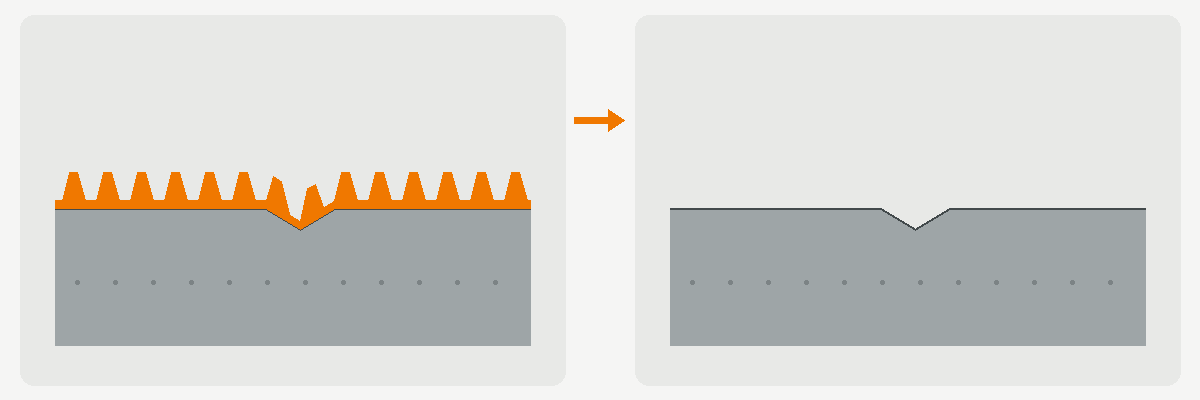
- Left: orange ridges and a thin orange film represent adhesive above the grey concrete.
- Right: removing that layer reveals the same underlying concrete profile, including its depression.
- The simplified cross-sections show different materials, not a specified removal depth or a finished-floor tolerance.
Once the residue becomes thin, further grinding may start removing concrete as well. That is why a brief should distinguish adhesive removal from lowering the floor. Ask what condition the remaining slab must meet, rather than requesting an arbitrary number of passes.
The exposed surface may still have hollows or an existing slope. Removing adhesive does not fill depressions or repair movement. Our guide to how much concrete grinding can remove explains the difference between removing a surface layer and changing the slab’s height.
Let the next floor define the required surface
The correct stopping point depends on the next flooring system. A surface being prepared for a coating may need a different texture and cleanliness from one receiving another tiled finish. A uniformly grey appearance is not an acceptance test by itself.
Ask the flooring installer or specifier to state whether any residue is permitted, the required surface texture, and how the prepared area will be accepted. Confirm those requirements before the removal quote is agreed, so each trade is working towards the same result.
Moisture, contamination, weak concrete and existing damage can still need assessment after the adhesive is removed. Grinding does not automatically resolve those issues. If a separate repair or preparation layer is required, identify who supplies it and when it follows the removal work.
What can an assessed trial area tell you?
After the material has been identified and the work assessed, a contractor may propose a small trial. This can reveal how the adhesive responds, how much remains between ridges, and what surface is exposed underneath.
A useful trial is checked against the intended flooring requirements. It can also reveal that the residue changes across the room, or that a second layer sits underneath. One successful patch does not prove that every part of the floor has the same construction.
Agree how an unexpected finding will be handled before work spreads across the full area. Changing the removal method, revising the finish requirement or obtaining further assessment may be more appropriate than continuing to grind deeper.
Edges and transitions need the same attention
A large machine can cover the open floor while leaving different work around walls, door frames, columns and fixed cabinetry. Ask whether edge work is included and how the contractor will reach the areas that the main grinding head cannot access.
Transitions deserve particular attention. Adhesive at a doorway can obscure the original slab height, and the new floor will add its own thickness. Mark adjoining floors, thresholds and drains so the removal work does not get confused with an instruction to change their levels.
Where a room will remain partly occupied, agree how work areas will be separated and handed back. Include removal of the resulting waste in the discussion, rather than assuming that a bare-looking slab means the whole removal task is finished.
Include dust control in the removal scope
Grinding concrete or other silica-containing material can generate respirable crystalline silica dust. The extraction or wet-control arrangement needs to suit the work, including smaller tools used at edges.
WorkSafe Queensland’s floor-grinder guidance explains source controls and clean-up. Ask the contractor how the proposed setup addresses the work area, nearby people and waste. An extractor visible beside a machine is only one part of that discussion.
What should you send with an adhesive-removal enquiry?
Provide the suburb, approximate floor area, wide photographs and close views of the exposed residue. Include available flooring or adhesive records, the material-identification outcome, access restrictions and the requirements for the new finish.
Ask the quote to distinguish removal of the old layer, preparation of the concrete, edge work, waste handling and the final inspection. For broader renovation questions, our concrete floor grinding guide explains how surface preparation fits into the rest of the project.
Sirius Concrete Cutters provides concrete grinding in Brisbane and the Gold Coast. Contact the team with photographs of the floor and the finish you need.