
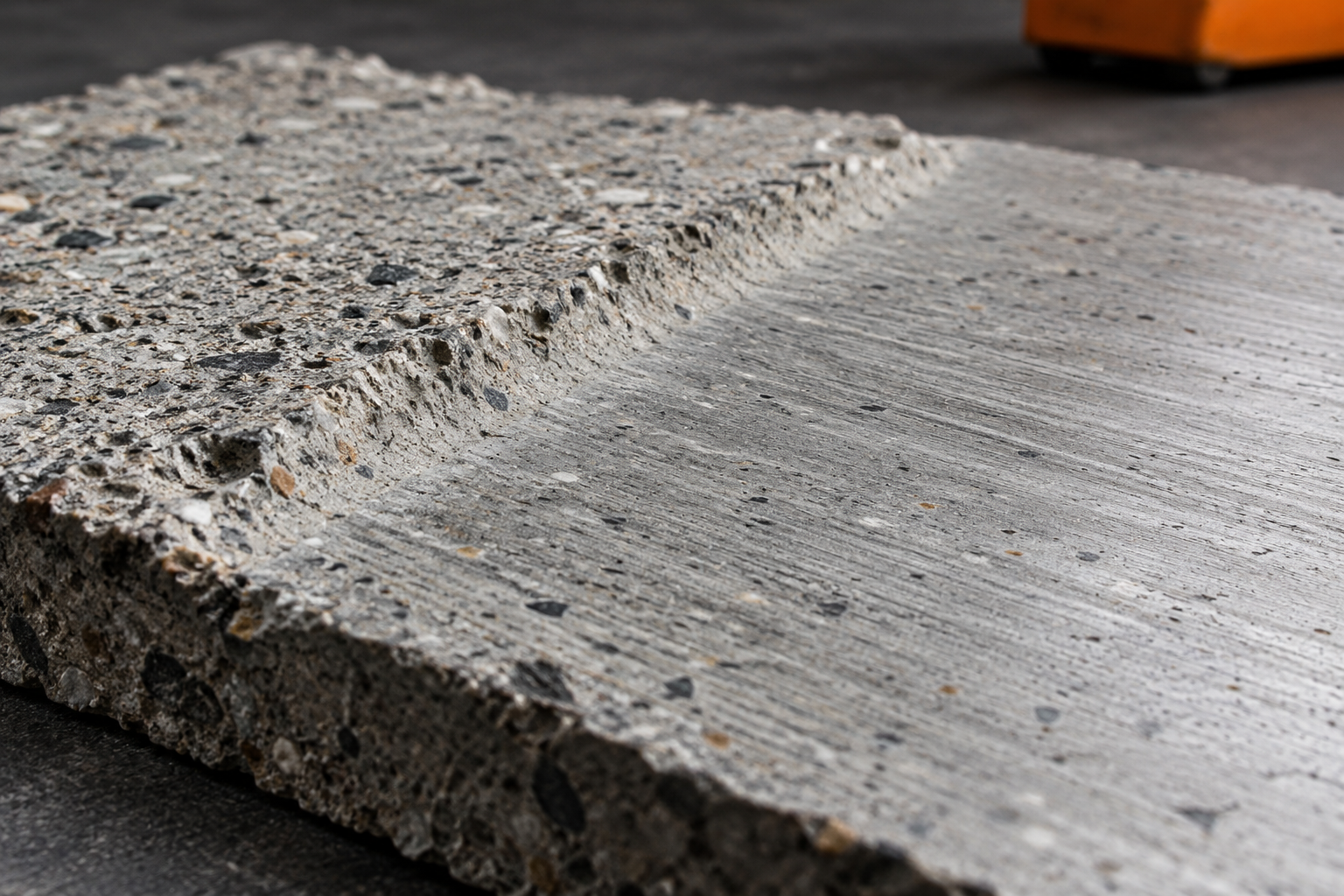
What determines how much concrete can be ground away?
There is no single removal depth that suits every concrete floor. The useful limit depends on the surface problem, the concrete that must remain and the height and texture required for the next finish. Removing a local high spot is a different job from lowering an entire slab.
Before choosing a contractor, it helps to separate three questions: what needs to come off, where it needs to come off, and what the remaining floor must achieve. A number quoted as millimetres per pass answers only a small part of that discussion.
For a Gold Coast or Brisbane project, Sirius Concrete Cutters’ concrete grinding service is the relevant starting point. A clear description of the floor problem makes it easier to discuss whether grinding suits the work.
Grinding removes material at the surface
Diamond grinding uses abrasive tooling moving against the concrete. Contact at the surface wears material away, leaving a changed surface behind. The result depends on the concrete, the tooling, the machine and the way the work is carried out.
A pass is a movement across an area, rather than a fixed unit of depth. Passing over two different floors does not establish that the same thickness will be removed from each. Nor does counting passes establish that a finished surface meets a specified height or texture.
It also matters which material is being removed. Taking off adhesive or an old coating means working through a layer above the concrete. Lowering the concrete underneath changes the slab itself. A photograph of a bare patch does not measure how much concrete has gone.
A high spot and a low spot need different thinking
Imagine a floor profile with a hump in one area and a shallow dip beside it. A reference line across the drawing helps show which material sits high. Reducing the hump removes concrete above that line; it does not put concrete into the dip.
This distinction explains why grinding can improve a local transition without making every part of a room meet the same plane. Chasing a low point by lowering all the surrounding concrete can turn a small surface correction into a much larger removal job.
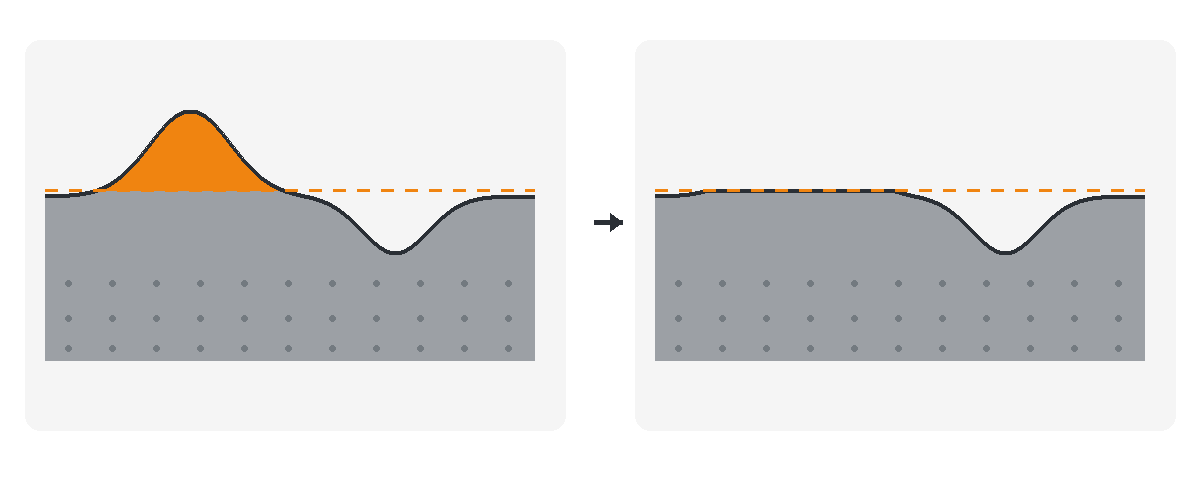
- Left: the orange area is the high material above the dashed reference line. The grey profile also contains a dip.
- Right: lowering the high area changes the top profile; the dip remains. Grinding removes material rather than adding it.
- The reference line helps distinguish a local height correction from changing the whole floor.
The Federal Highway Administration’s Concrete Pavement Preservation Guide describes diamond grinding as removing high areas relative to a reference plane. The same geometric distinction helps explain a floor enquiry: the height difference and its location matter, alongside the overall area.
If a dip needs material added, that is a separate repair or preparation decision. Grinding alone does not fill it. The flooring specification and the condition of the slab determine how those different tasks should fit together.
Flat, level and smooth describe different results
A floor can be flat while sloping. Flatness concerns departures from a plane; level concerns its relationship to horizontal. A smooth surface can still have a broad slope or a low area that is difficult to see in a close photograph.
That matters at doors, adjoining rooms and drainage points. Lowering one high edge may improve a transition, while lowering a wider area may change the relationship to a threshold or an intended fall. The desired result needs a reference, rather than an instruction to make everything look smooth.
Ask what will be measured after the work. It might be a local height difference, a specified flatness requirement or a surface texture for the next finish. These are different checks, and one photograph cannot stand in for all of them.
A small depth can represent a large amount of material
The volume removed depends on both area and average depth. As a simple calculation, a uniform 1 mm layer over 10 square metres occupies 0.01 cubic metres, or 10 litres, before it is broken up or mixed with water.
That is a volume example, not a suggested grinding depth. It shows why removing a thin layer across a whole room differs from reducing one small ridge. The maximum depth at a single point and the average depth over the work area are different quantities.
Area alone can therefore make two quotes look more similar than their scopes really are. One may concern isolated high spots; another may concern continuous preparation over the entire floor. Marking the affected areas helps show what the proposed removal actually covers.
The concrete that remains matters as much as the layer removed
A surface target does not establish permission to remove the material above it. The remaining slab, reinforcement cover, embedded items and the purpose of the concrete need to be considered when a proposed reduction could affect them.
Existing drawings, previous alterations and known defects can change the assessment. Where removal raises a structural question, the responsible qualified designer needs to define the permitted change. An equipment capacity or an online depth figure cannot establish that allowance.
Cracks and movement also deserve their own assessment. Taking material off the top can change the appearance of a surface without resolving the reason it cracked or moved. A request to remove a lip should identify whether the cause has been investigated.
The next floor finish sets another boundary
A floor prepared for a coating may need a different texture from one intended to remain exposed. Removing more concrete can also expose more aggregate or reveal variation between areas. Depth and appearance are connected, but they are not interchangeable specifications.
The next flooring system may have requirements for surface condition, moisture and preparation. Agree who will assess those requirements and accept the prepared floor. A grinding quote should describe its part of the work without assuming it covers every later flooring task.
For the wider preparation discussion, our concrete floor grinding guide provides related context. The grinding planning guide also outlines the information to clarify before work is scoped.
What to ask before accepting a grinding quote
Start with the problem and the required finish. Provide the approximate area, photographs, marked high or low areas, nearby thresholds and any available floor measurements. Include the next flooring specification and drawings where relevant.
Then ask whether the scope concerns coating removal, surface preparation, isolated height correction or a broader reduction. Confirm the reference for any height target, the proposed acceptance checks and which conditions would require the scope to be reassessed.
Allow for the work environment too. Safe Work Australia identifies grinding concrete as a task that can generate silica dust. Dust controls, isolation, nearby occupants and waste handling belong in the site discussion; a shallow removal does not make those questions disappear.
The useful answer to “how much can be removed?” is therefore a defined result for the actual floor: the affected area, permitted removal, remaining concrete and required finish. Those details give a contractor something meaningful to assess.
Read about concrete grinding with Sirius Concrete Cutters on the Gold Coast or in Brisbane, then get in touch with the floor details and the finish you need.