
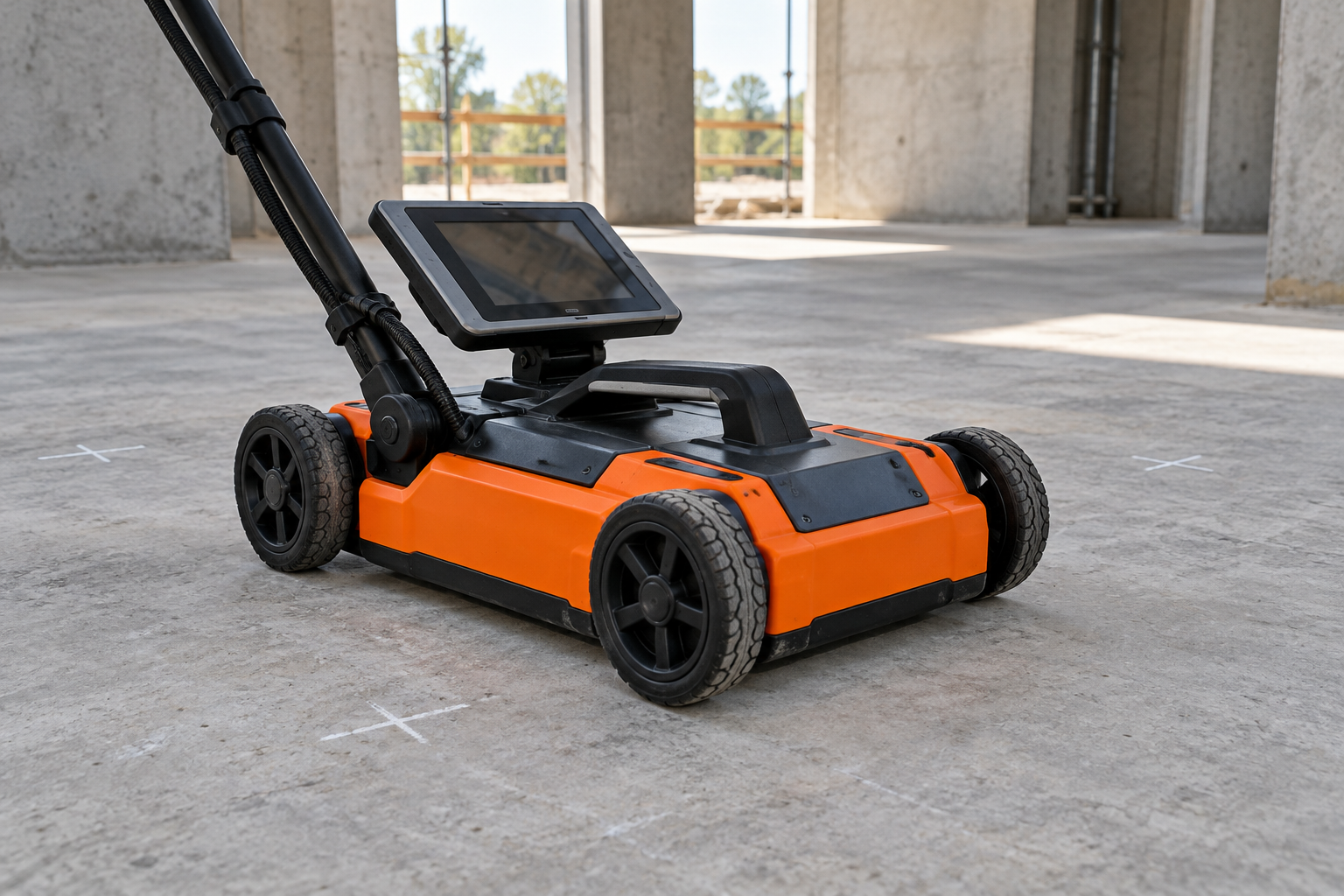
Concrete scanning is a broad description of investigating what is inside concrete. Ground-penetrating radar (GPR) and concrete X-ray are different methods: GPR records reflected radio signals, while conventional radiography records radiation passing through the concrete. The method affects access, site controls and the information available for a proposed cut or hole.
If you are arranging a pipe penetration or a new opening, the useful question is what the investigation needs to establish. Asking for “an X-ray” without naming the method can leave the contractor and project team discussing different scopes.
For work on the Gold Coast or in Brisbane, start with Sirius Concrete Cutters’ concrete scanning service. Share the proposed work and available drawings, then discuss the investigation method and the findings needed before cutting or drilling.
GPR listens for reflections within the concrete
A GPR antenna sends short radio-wave pulses into the concrete and receives returning signals. Changes in material properties can reflect some of that energy. Moving the antenna across the surface builds a record of responses along its route.
The Federal Highway Administration’s explanation of concrete GPR describes this reflection process and how reinforcement and material conditions affect the signal. GPR uses non-ionising radio waves; it is not an X-ray source.
Think of the result as evidence to interpret, rather than a photograph with every object already labelled. A response may help locate an embedded feature, but its identity and significance still need assessment. Our guide to radar return time and concrete depth explains why even a depth estimate involves more than reading a time value.
Concrete X-ray uses a different signal path
In a conventional transmission radiography arrangement, the source sits on one side of the element and the detector or film sits on the other. Radiation passes through the material. Differences in how much reaches the detector form the image.
The US Environmental Protection Agency’s introduction to industrial radiography explains that arrangement. Industrial radiography can use X-rays or gamma rays, so it is worth confirming the actual technology when the word “X-ray” appears in a brief.
Both methods investigate without cutting the proposed opening first. They collect different evidence, however, and their equipment layouts are different. A quote should identify the method instead of treating “scanning” and “X-ray” as interchangeable descriptions.
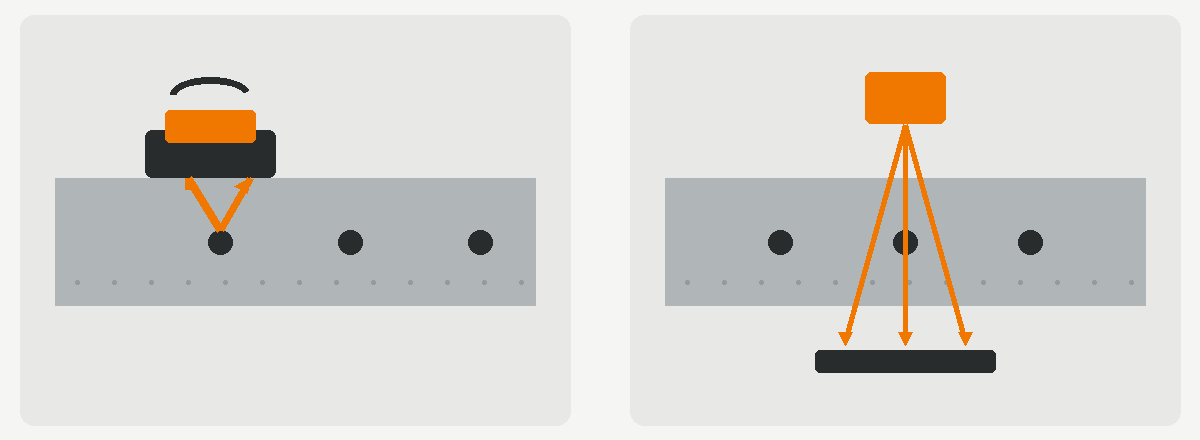
- Left: the scanner is on the accessible face. Orange paths show a pulse travelling to an embedded feature and returning to the receiver.
- Right: the orange source is above the concrete and the dark detector is below it. The orange paths pass through the element.
- Dark circles represent embedded features. These simplified paths explain the two arrangements without prescribing an equipment setup.
Access to the other face can change the options
Surface GPR normally places its transmitting and receiving antennas on the accessible face. Conventional transmission radiography needs a workable source-to-detector path through the element, including access for the detector on the opposite side.
Consider a suspended floor above an occupied tenancy. Permission to enter the upper room does not automatically provide access to the ceiling below. Photographs of both spaces, ceiling finishes and access restrictions help establish whether the proposed investigation arrangement is practical.
A ground-supported slab presents a different access question because its underside is not an open working surface. Explain that construction before booking. The investigating specialist needs to match the available access to the information sought, rather than promise a method from the room’s floor area alone.
Ask what might remain unclear
GPR does not see through metal as though the reinforcement were transparent. Dense reinforcement can obscure deeper features, while moisture and conductive material conditions can reduce signal penetration. A scan of one surface cannot be assumed to describe every layer beneath it.
Radiographic image quality also depends on the inspection arrangement and the material in the radiation path. An image of a particular region should not be stretched into a claim about an unexamined neighbouring area. Ask what the selected method can resolve for the actual element.
For either method, request a clear account of the investigated area and any uncertainty. “Nothing identified in this region” and “every possible obstruction has been ruled out” are different conclusions. The report or discussion should preserve that distinction.
Radiography needs its own site arrangements
X-rays and gamma rays are ionising radiation. ARPANSA’s industrial radiography guidance explains the importance of trained operators, controlled areas and radiation safety procedures. Those requirements belong in the work planning, including coordination with other occupants and trades.
Ask the radiography provider to define the access and exclusion arrangements for that job. Do not assume the testing can happen while everyone continues working beside the equipment, or that a previous job’s arrangements apply to this one.
GPR’s different signal does not remove ordinary site planning. The operator still needs suitable access to move the equipment over the required surface. Obstacles, finishes and activity around the work area can affect the investigation scope.
A finding is separate from permission to cut
Locating an embedded feature answers a different question from deciding whether it may be cut. A proposed hole can affect reinforcement or intersect a service. Those issues need the responsible project people to review the findings alongside the intended work.
Identify suspended or post-tensioned construction and structural uncertainties at the start. Scanning information does not replace the relevant engineering assessment or authorisation. The cutting contractor needs the agreed location and scope, rather than an assumption that the scan alone settled every question.
If the opening moves after the investigation, check the new location against the recorded coverage. A result tied to the original circle on a drawing does not automatically transfer to a circle beside it. Keep the drawing, site markings and later work instructions consistent.
Compare the investigation scope before comparing quotes
Two quotes labelled “concrete scan” may cover different areas and deliver different information. One may address nominated penetration locations; another may include broader mapping and a written record. Ask what is included and how the findings will be handed over.
Provide the suburb, building level, element, proposed hole or cut dimensions and intended depth. Include access photographs, available structural and service drawings, known alterations and any flexibility to move the work. Flag uncertain information so it can be addressed.
Confirm the proposed method, coverage, access arrangements, deliverables and who will review the result. Our guide to what changes a concrete GPR scan’s cost explains why the area alone does not define the investigation.
Sirius Concrete Cutters offers concrete scanning on the Gold Coast and in Brisbane. Get in touch with your marked work area and site details to discuss the investigation before cutting or drilling.