
Summary
A kerf is the slot left by a cut. Its width runs across that slot, while penetration depth runs into the material. Blade diameter describes the tool’s circle. These three dimensions answer different questions and cannot be substituted for one another.
For related work, see Sirius Concrete Cutters’ floor sawing service.
Start with the space left behind
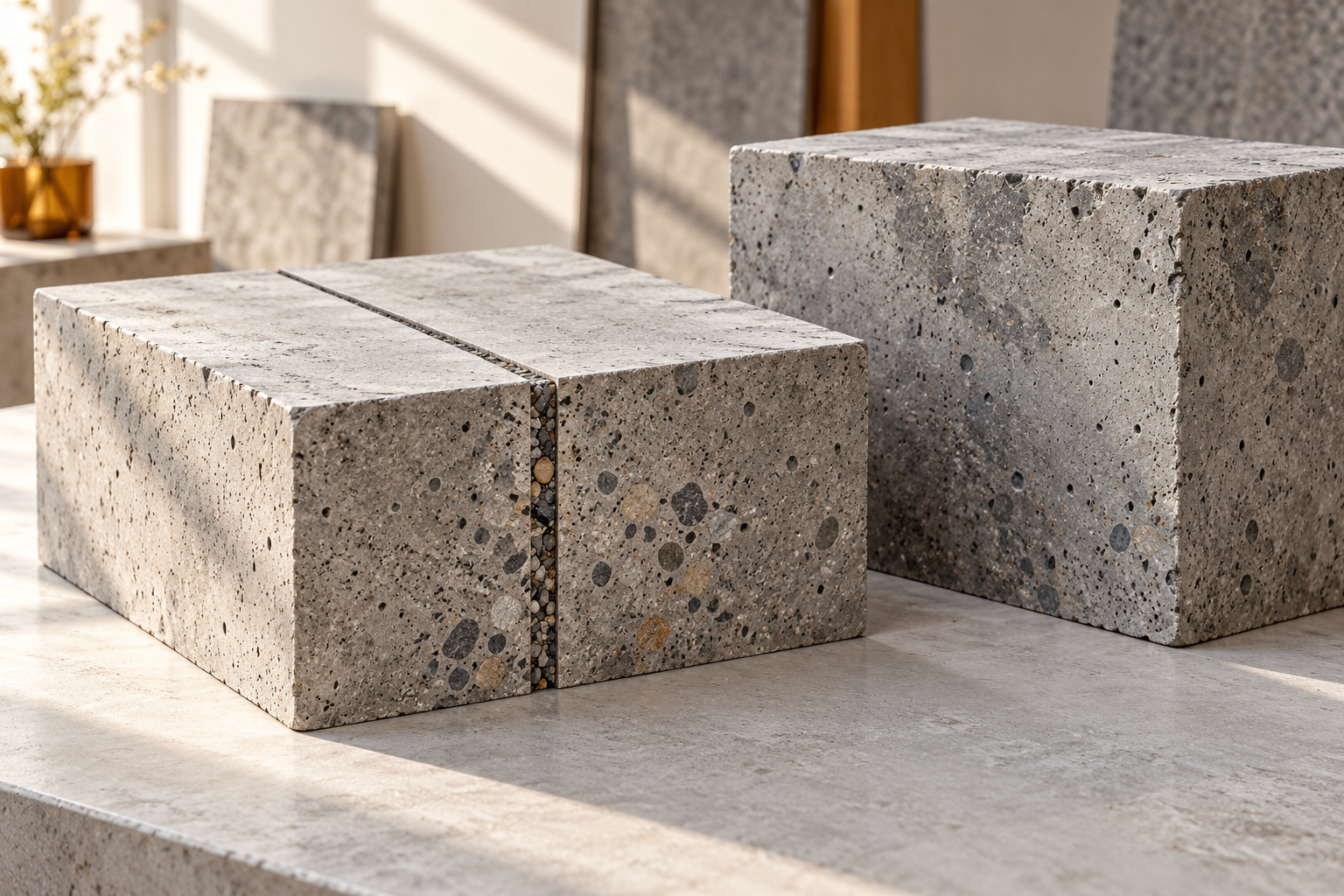
A straight cut leaves a narrow space in the material. That space is called the kerf. Seen from above, it looks like a line with some width. Seen from the end, it also has depth. The same cut therefore has more than one dimension, even when a photograph makes it look like a single dark mark on a slab.
Imagine a rectangular piece of cardboard with a thin slot drawn through its thickness. Looking down at the face tells you where the slot runs and how wide it is. Looking at the edge tells you how far it extends below the face. Neither view alone provides the complete shape. Concrete is a different material, but the distinction between these directions is the same.
Across the cut and into the cut
Kerf width is measured across the opening, perpendicular to its length. Penetration depth is measured from the original surface into the material. A long cut can have a narrow kerf. A short cut can have the same width. The length along the planned line is a third dimension of the resulting slot, separate from both width and depth.
This is why a phrase such as a bigger cut can be ambiguous. It might mean a longer line, a wider slot or greater penetration. Describing the direction removes that ambiguity. A drawing with a plan view and an end section communicates more than a large number attached to an unspecified cut. It also makes clear which surface provides the starting reference.
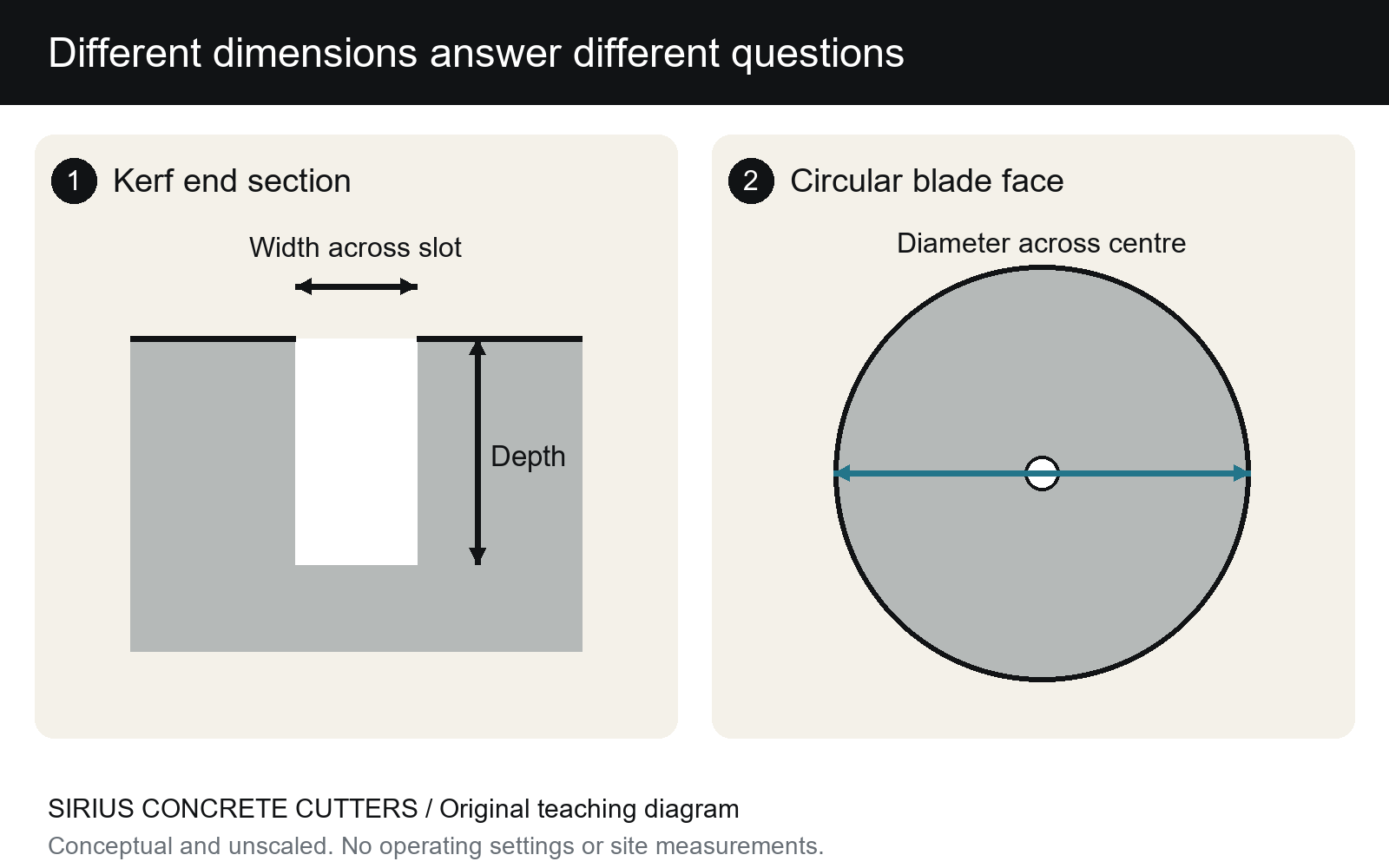
- 1. In an end section, kerf width runs across the slot and penetration depth runs into the material.
- 2. Blade diameter runs across the circular face through its centre.
The blade has its own dimensions
A circular blade’s outside diameter is measured across its centre from one rim to the opposite rim. Its radius runs from that centre to the rim. Its thickness runs across the disc, in a different direction again. A side view makes the diameter obvious; an edge view makes thickness easier to see. Neither dimension is a description of an entire finished opening.
Consider a coin standing on its edge as a geometry model. The distance across its round face differs from the thickness seen edge-on. Making the coin larger in diameter does not, by definition, make it thicker. Real cutting blades have more complicated construction than a coin, but the example helps keep two independent tool dimensions separate in the reader’s mind.
Why diameter is not a penetration promise
Only part of a circular tool may project into the material during a particular operation. The centre, mounting arrangement, guards and machine geometry occupy space too. It follows that the outside diameter of a blade is not itself a statement of the depth available in a particular setup. Knowing one tool dimension does not identify all the clearances around it.
A sketch of a full circle halfway submerged in a slab can be misleading if it is read as a machine specification. It omits the supporting assembly. Our diagram therefore separates the blade’s circle from a generic end section of a kerf.
The cutting edge and supporting disc
Husqvarna’s K1 PACE family operator’s manual identifies a steel core and diamond-bearing segments. Its illustration also distinguishes segment width from the supporting blade thickness. That manufacturer example helps explain why the widest working part and the middle of a blade need not be identical.
The resulting slot also belongs to an actual cutting process. A catalogue dimension should not be casually relabelled as a measured finished opening. Tool condition, movement and the material matter to the work. For this explanation, the useful point is geometric: a tool measurement and a measurement of the space it leaves describe related objects, rather than the same object.
A finished opening is another shape
An opening cut into a wall or floor is usually described by its overall boundary. That boundary can involve several cut lines. The narrow kerfs along those lines are not the same as the width and height of the whole opening. Confusing the two can turn a sensible drawing into an unclear verbal description, especially when discussing an existing marked area.
For example, the distance between two parallel cut lines describes the intended strip between them. Each line may also have its own kerf width. These widths do not become the distance between the lines. A plan view that shows the retained material, the removed portion and the cut lines can keep all three parts visible without relying on the word width alone.
Read the view before reading the number
An end section is a slice through the material. A plan view looks down on its surface. A side elevation looks across it. The same feature can appear as a rectangle, a line or a circle depending on the view. Before comparing two dimensions, identify which view they belong to and which direction the dimension arrow points.
This habit is useful well beyond cutting. A photograph taken at an angle can make a shallow slot look deeper or a wide gap look narrow. Perspective changes appearance, while a dimensioned drawing declares a reference. The image and the drawing provide different kinds of information; a striking photograph cannot fill in dimensions that were never measured.
Use precise words for a real enquiry
Sirius provides concrete cutting services with the Gold Coast as its primary market and Brisbane as a secondary market. Its floor-sawing information separates the proposed cut from the details needed to assess the actual work. Describing the material, marked area, thickness and access helps connect an enquiry to the real site rather than an assumed machine capacity.
The lasting lesson is to keep the dimensions attached to their objects. Kerf width belongs across the slot. Penetration depth belongs into the material from a reference surface. Blade diameter belongs across the tool’s circular face. Once those directions are clear, a discussion about a cut becomes much easier to follow without turning a diagram into a promise about a particular job.
Sources and further reading
Husqvarna K1 PACE / Rescue / Rail operator’s manual, version 1598-010, 10 September 2025, pages 17–18.
Sirius Concrete Cutters’ current service information.
Related reading: Why a circular cut can end differently on two faces and Why a diamond blade has a supporting core and a working rim.
Sirius Concrete Cutters provides floor sawing on the Gold Coast and in Brisbane. Get in touch to discuss your project.