
Summary
A segmented diamond blade combines a supporting disc with diamond-bearing material at its rim. The core and the working segments have different roles. The name diamond blade does not mean that the entire disc is one piece of diamond.
For related work, see Sirius Concrete Cutters’ floor sawing service.
A name can hide a composite tool
The words diamond blade naturally draw attention to diamond. They can also create the wrong mental picture: a transparent disc made entirely from the gemstone. A typical segmented construction blade is a combination of parts and materials. Its broad central disc supports a working rim, where diamond abrasive is incorporated into the cutting segments.
Looking at the tool from a distance, the central disc occupies most of the visible area. Looking only at the name, the abrasive attracts most of the attention. Both views leave something out. Understanding the blade means asking what each part does and how the parts work together, rather than expecting one material to perform every role.
The core provides a supporting shape
Husqvarna’s K1 PACE family manual describes diamond blades with a steel core and segments containing industrial diamonds. The core gives the tool its disc-shaped body and connects the rim to the central mounting region. Calling it a support does not mean it is unimportant to the assembly.
Think about a wheel and its tyre. The comparison is imperfect, but it shows why the part contacting a surface and the part supporting that contact can be different. Describing only the tyre would omit much of the wheel. Likewise, describing only diamond grains omits the body that carries them around the blade’s axis of rotation.
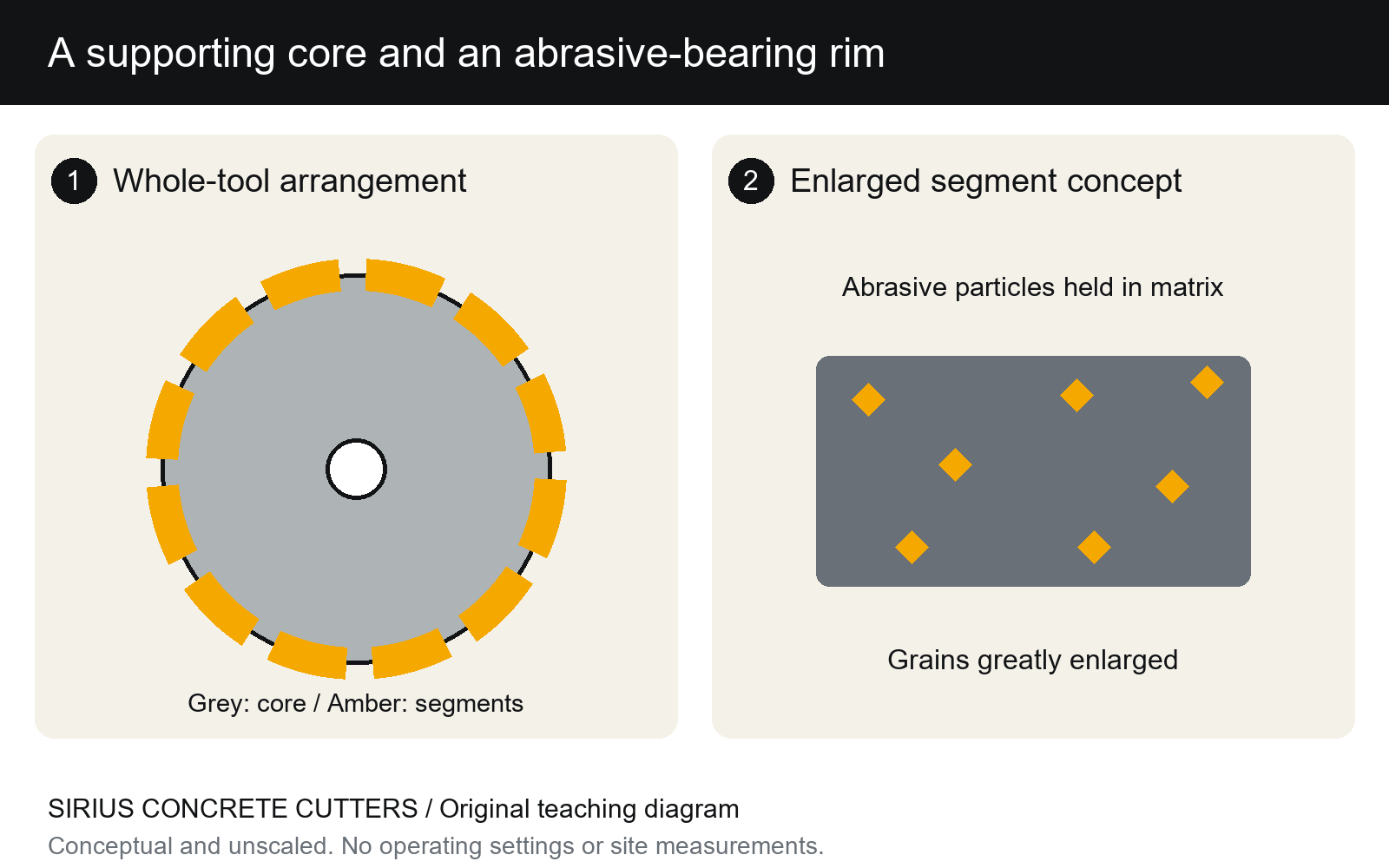
- 1. The core supports the disc-shaped tool; the segmented rim carries working abrasive material.
- 2. Enlarged conceptual segment: diamond grains (amber) are held within a supporting matrix (grey).
The segment is more than a single grain
At the working rim, small diamond abrasive particles are held within a supporting material commonly called the bond or matrix. A segment is not one large diamond tooth. It contains a population of abrasive particles in a manufactured body. The drawing exaggerates individual particles so that this relationship can be seen without pretending to show their actual size.
This construction gives the word diamond two scales of meaning. At the microscopic scale it identifies the abrasive particles. At the whole-tool scale it names a category of blade. Those meanings are connected, but they are not interchangeable. The presence of diamond abrasive at the rim does not tell you that the centre, mounting area or every visible surface is diamond.
Support and contact are different jobs
The central body helps maintain the assembly’s shape and carry the rim. The exposed abrasive interacts with the material being cut. The matrix holds and supports abrasive particles within the segment. These jobs occur together in one tool, which is why a simple ranking of one part as the only part that matters misses the mechanism.
A useful everyday analogy is sandpaper. Abrasive grains, the material holding them and the backing all contribute different functions. A sheet made only from loose grains would not behave like a supported abrasive sheet. The analogy is about combined roles, not an assertion that sandpaper and a diamond cutting blade share the same construction, loads or method of use.
Why the rim can look interrupted
On a segmented blade, the rim is divided into sections with spaces between them. The visible pattern makes it easier to identify the distinction between the broad core and the outer working parts. Other blade designs can have different rim arrangements. An illustration of one segmented form should not be treated as a catalogue of every diamond blade type.
The spaces in a drawing do not provide a measurement or an operating recommendation. Their shape and size belong to a particular design. Here they simply make the relationship legible: a disc-shaped support occupies the centre, while separate diamond-bearing sections occupy positions around its outside. A real manufacturer’s identification and instructions remain necessary to understand an actual product.
The bond is not the concrete binder
The word bond appears in several construction contexts. In a diamond segment, it refers to the material that holds the abrasive particles. In a concrete mix, cementitious binder is part of the material being cut. Confusing these two uses can produce a sentence that sounds technical but connects the wrong materials. One belongs to the tool; the other belongs to the workpiece.
Keeping those locations clear also helps explain a cut surface. Aggregate and hydrated cement paste are parts of the concrete. Diamond and its supporting matrix are parts of the abrasive tool. The contact brings different material systems together. An explanation of either system should first identify which side of that contact it is describing.
Hardness does not describe every useful property
Abrasive hardness helps explain the interest in diamond, but hardness is not a complete description of a tool. Stiffness, shape, connections, support and the response of an assembly to its working conditions are separate considerations. A material can be very hard without being the right material for every component. A name based on one property cannot specify the complete design.
For the same reason, more visible diamond in a promotional picture is not enough to compare two blades. The picture may be an enlargement, a simplified rendering or a view of only one part. Without a defined product and relevant evidence, it cannot establish service life, cutting speed or suitability.
An assembly needs its own context
Sirius’s current floor-sawing page provides the appropriate service context for a proposed concrete cut. For a reader, the useful new understanding is smaller and more durable than a product claim: a diamond blade is a combined tool. Its central support, abrasive-bearing segments and individual diamond particles occupy different places and perform different jobs within the same rotating assembly.
Sources and further reading
Norton Abrasives, Understanding Diamond Blades, 1 May 2017: manufacturer explanation of the core, abrasive segment and bonding system.
Husqvarna K1 PACE / Rescue / Rail operator’s manual, version 1598-010, 10 September 2025, pages 17–18.
Sirius Concrete Cutters’ current service information.
Related reading: Kerf width, cut depth and blade diameter describe different things and Why one full turn covers more distance at a larger radius.
Sirius Concrete Cutters provides floor sawing on the Gold Coast and in Brisbane. Get in touch to discuss your project.