
Summary
Diamond and graphite are different structural forms of carbon. Their atoms have different bonding arrangements: diamond has a connected three-dimensional network, while graphite has strongly bonded sheets with much weaker connections between sheets. Composition alone therefore does not explain a material’s behaviour.
For related work, see Sirius Concrete Cutters’ floor sawing service.
The same ingredient can have a different arrangement
Diamond and graphite seem like unlikely relatives. One is associated with hard abrasive particles and gemstones; the other with the dark mark left by a pencil. Both are forms of the element carbon. Their contrast is a useful reminder that identifying the atoms in a solid is only part of describing the material. How those atoms connect also matters.
The chemistry term allotrope names different structural forms of the same element. It does not mean a mixture of two elements or a coating applied over another substance. In this case the comparison concerns carbon arranged in different repeating structures. A list of ingredients that simply says carbon leaves that structural difference unanswered.
Connections extend in different directions
In diamond, carbon atoms form a three-dimensional network of strong covalent bonds. Each carbon has four neighbouring carbon atoms in the ideal structure. The connected arrangement extends through the crystal rather than being confined to a stack of separate flat sheets. Moving one part of that network relative to another involves a different situation from sliding one sheet over its neighbour.
Graphite has strongly bonded carbon sheets. Within a sheet, each carbon connects to three neighbours in a repeating arrangement. Connections between the sheets are much weaker than the bonds within a sheet. The contrast between directions is central to the explanation. Calling graphite weak without saying which connections are meant would miss its strong bonding within each layer.
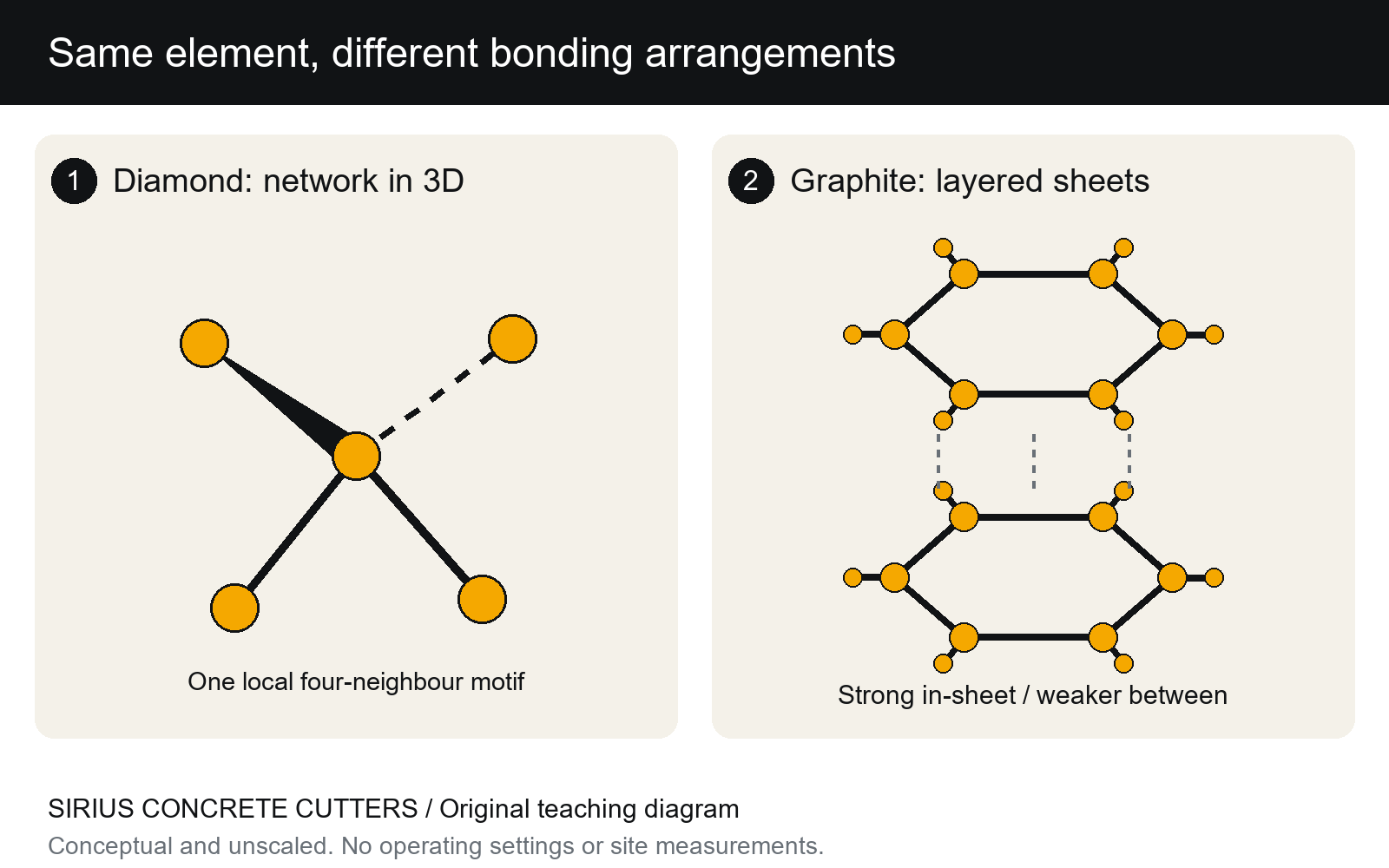
- 1. A local diamond motif shows a carbon atom connected to four neighbours; the network continues in three dimensions. The dark dashed bond indicates perspective, not a weaker bond.
- 2. Graphite sheet fragments show hexagonal rings of strong carbon bonds; grey dashed lines between the sheets represent weaker interlayer interactions.
- Dots are carbon in both panels. Short outward bonds indicate continuing sheets.
A diagram needs more than different colours
Our illustration uses the same coloured dots for carbon in both panels. The colour therefore does not pretend that diamond and graphite contain different elements. The lines and their arrangement carry the distinction. One panel suggests connected bonds extending through space; the other separates two strongly connected sheets with weaker interactions between them.
Why a pencil can leave a mark
Graphite’s layered structure helps explain why material can be transferred from a pencil to a surface. Layers can move relative to one another more easily than the strong bonds inside each sheet would suggest on their own. The visible mark is evidence of material being deposited, rather than proof that the carbon atoms have changed into a different element.
An ordinary pencil lead is also a manufactured mixture, not a perfect single crystal of pure graphite. The atomic structure explains an important part of graphite’s behaviour. It does not state the complete formulation or performance of every pencil, lubricant or carbon-containing material.
Why diamond is useful as an abrasive
Diamond’s bonded network helps account for its exceptional hardness. In cutting tools, small industrial diamond particles can provide abrasive working points. This does not mean that a whole construction blade is a diamond crystal. A tool can combine diamond-bearing working material with other supporting parts, each chosen for a different function within the assembly.
Hardness describes resistance to indentation or scratching under a defined comparison. It is not a synonym for indestructible, and it does not establish the complete performance of a tool. Shape, support, condition and the material being worked also matter. The structural explanation therefore supports an understanding of the abrasive, rather than a promise about any cut or blade.
Composition and structure answer different questions
Composition asks what a material contains. Structure asks how its constituents are arranged and connected. Those questions often interact, but neither can replace the other. Two samples can share an elemental description while differing in the arrangement responsible for their properties. Diamond and graphite make this distinction especially clear because both are familiar names for carbon materials.
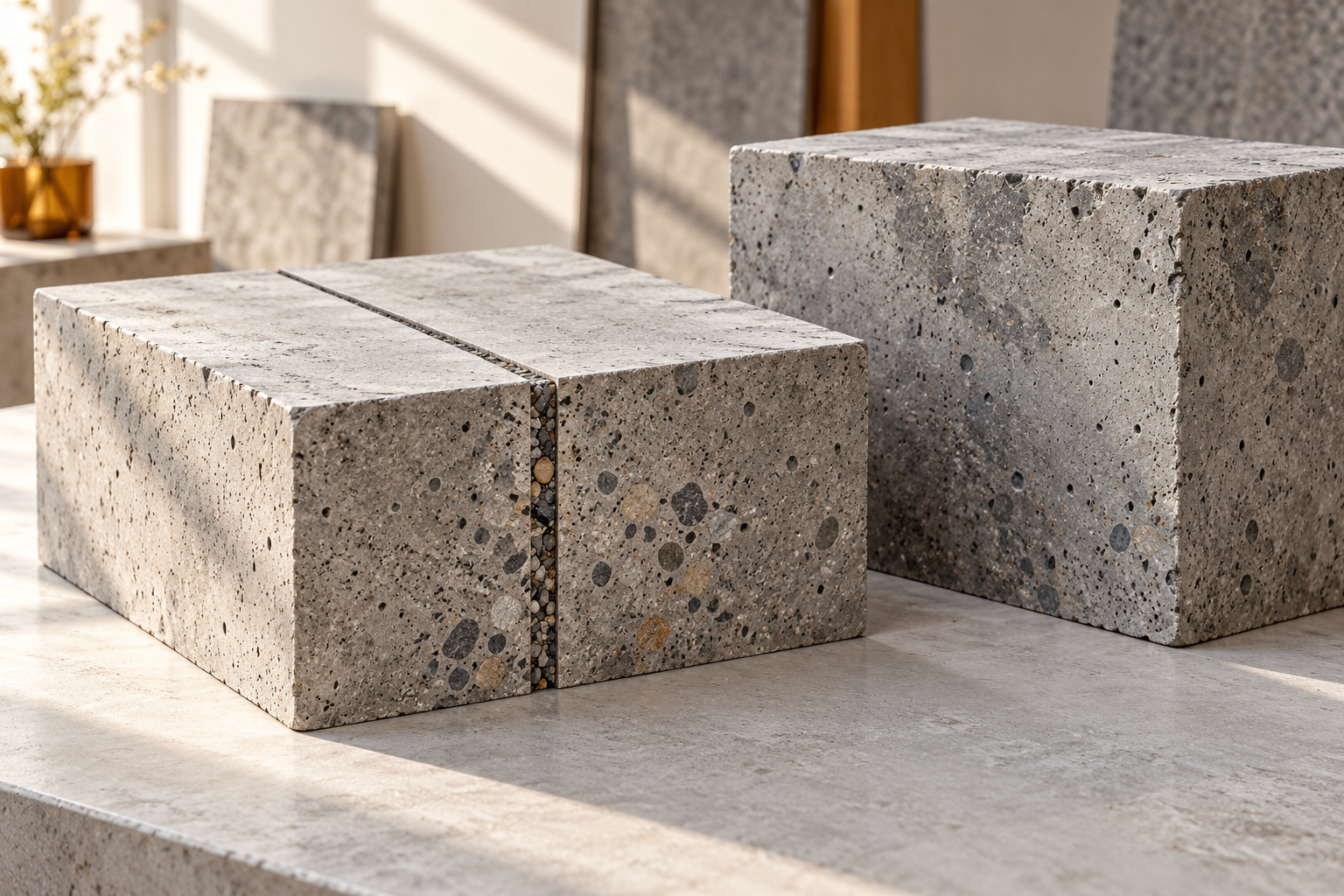
The same habit of asking both questions is useful when looking at building materials. A grey surface does not reveal every constituent or its arrangement. A name such as concrete covers a family of composite materials rather than one chemically uniform substance. This does not make concrete another carbon allotrope; it shows why a useful description often needs more than an ingredient name.
A small idea that changes the way we read names
The cited OpenStax chemistry section explains covalent network solids and the contrast between diamond and layered graphite. The underlying lesson is that a material’s name can refer to a particular arrangement as well as its constituent element.
Sirius’s concrete cutting information supplies the practical setting for readers curious about diamond tools. The chemistry adds a deeper explanation of one familiar word. When diamond appears in a blade description, it identifies an abrasive material whose bonded structure helps explain its hardness. It does not mean that every carbon material behaves alike, or that composition alone describes the whole tool.
Sources and further reading
OpenStax Chemistry 2e, section 10.5: The Solid State of Matter.
Sirius Concrete Cutters’ current service information.
Related reading: Why a diamond blade has a supporting core and a working rim and Why concrete is a composite rather than one uniform substance.
Sirius Concrete Cutters provides floor sawing on the Gold Coast and in Brisbane. Get in touch to discuss your project.