

Summary
All points on a rigid disc complete the same angular turn together, but points farther from its centre travel along longer circular paths. Angular rotation and linear travel therefore describe different quantities.
For related work, see Sirius Concrete Cutters’ floor sawing service.
Two marks on one turning disc
Imagine two coloured marks on a rigid disc. One is near the centre and the other is near the outside edge. Turn the disc through one complete revolution. Both marks arrive back at their starting positions at the same time. Each has completed the same angular turn, but they have not travelled the same distance along their paths.
The outer mark follows a larger circle. The inner mark follows a smaller circle. This difference is easy to overlook when rotation is described only as a number of turns. A turn counts orientation around the centre; distance counts the length of the path. The two descriptions are connected by the radius of the point being followed.
Circumference links a circle to its radius
The circumference of a circle is two times pi times its radius. Doubling the radius therefore doubles the circumference. For a full turn, a mark at twice the radius travels twice the path length. This is a geometric comparison using a fixed ratio.
Our diagram uses two imagined tracks on one disc to keep the relationship visible. Both tracks cover a complete turn, while one circle is larger. The outer track is longer because of its larger radius, not because its mark completed more revolutions or started earlier than the mark on the inner track.
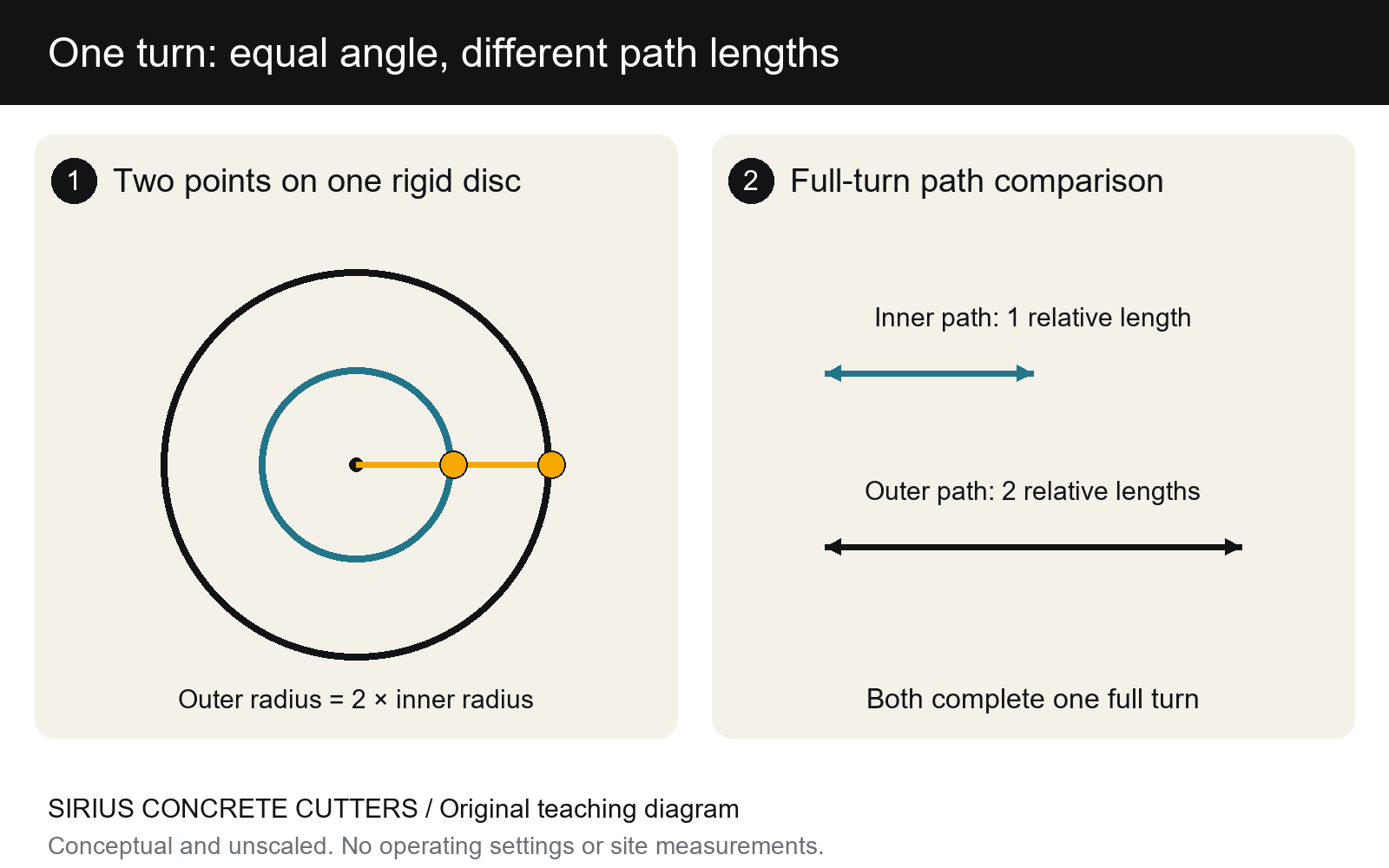
- 1. Points fixed at two radii on one rigid disc share its angular turn. Here the outer radius is twice the inner radius.
- 2. Their full-turn path lengths have the same 2:1 ratio, because circumference = 2πr.
Angular movement counts the turn
Angular displacement describes the change in orientation about the centre. A quarter turn, half turn and full turn express familiar fractions. Degrees and radians are units used to describe angles more formally. A rigid disc turns as one body, so points fixed to it share the same angular movement even though their distances from the centre differ.
This statement concerns rotation about the same axis. It does not mean every point has the same linear motion through space. A point at the exact centre can remain in place while the disc turns around it. A point away from the centre moves along a circle. Their shared angular description does not erase that difference in position and path.
Time introduces two kinds of speed
Angular velocity describes how quickly the angle changes. Tangential speed describes how quickly a point travels along its circular path. For a point at a fixed radius on a rotating rigid body, tangential speed equals radius multiplied by angular velocity. The OpenStax physics section on rotation explains this relationship.
If the angular velocity is held the same, a point at a larger radius covers more path in the same time. If the radius changes while a desired tangential speed is held the same, the angular velocity would have to change. These are different comparisons. A sentence about faster rotation is incomplete unless it says which quantity is being compared.
A useful comparison without operating numbers
Picture two unpowered cardboard discs turning once over the same time interval. The larger disc’s edge follows a longer path during that interval. We can understand the ratio without choosing a machine speed or a real blade diameter.
More path does not automatically mean more cutting
Distance travelled by an abrasive point is one aspect of motion. It does not state how much material is removed during that travel. Contact conditions, abrasive construction and the workpiece belong to a different part of the explanation. Converting a path-length ratio into a removal-rate ratio would add a claim that the geometry itself never established.
The same is true of time. One revolution completed more quickly changes the rate of motion, but it does not by itself describe the outcome at a material contact. A turning disc in free space and an abrasive tool interacting with concrete can share a geometric description while differing completely in what happens at the rim.
Read arrows carefully in a rotating diagram
A curved arrow can show direction around the centre, the amount of a turn or the path of a particular point. Those are related ideas that need clear labels. An arrow twice as long on a page does not necessarily mean twice the rotational speed. Its length may simply follow a larger drawn circle or make the illustration easier to read.
Our numbered explanation identifies the inner and outer paths and the shared full turn.
One relationship, two useful descriptions
Sirius’s floor-sawing information provides the practical context for readers interested in circular cutting tools. The geometry adds a clearer way to read descriptions of rotation. When a statement gives turns per unit of time, it describes angular motion. When it gives distance per unit of time along a rim, it describes linear motion at a particular radius.
Neither description is wrong; each answers a different question. The connection is the radius. One full turn always completes the same angular journey, while the length of the circular path grows with distance from the centre. Keeping that relationship visible helps explain rotating tools.
Sources and further reading
OpenStax Physics, section 6.1: Angle of Rotation and Angular Velocity.
Sirius Concrete Cutters’ current service information.
Related reading: Why a diamond blade has a supporting core and a working rim and Kerf width, cut depth and blade diameter describe different things.
Sirius Concrete Cutters provides floor sawing on the Gold Coast and in Brisbane. Get in touch to discuss your project.