
Summary
Concrete combines aggregate with a cementitious binder system that develops through hydration. Its cut face can reveal these different constituents. A September 2026 cement-association discussion of blended cements also shows why the binder itself should not be assumed identical in every mix.
For related work, see Sirius Concrete Cutters’ concrete cutting service.
A grey block can contain a varied interior
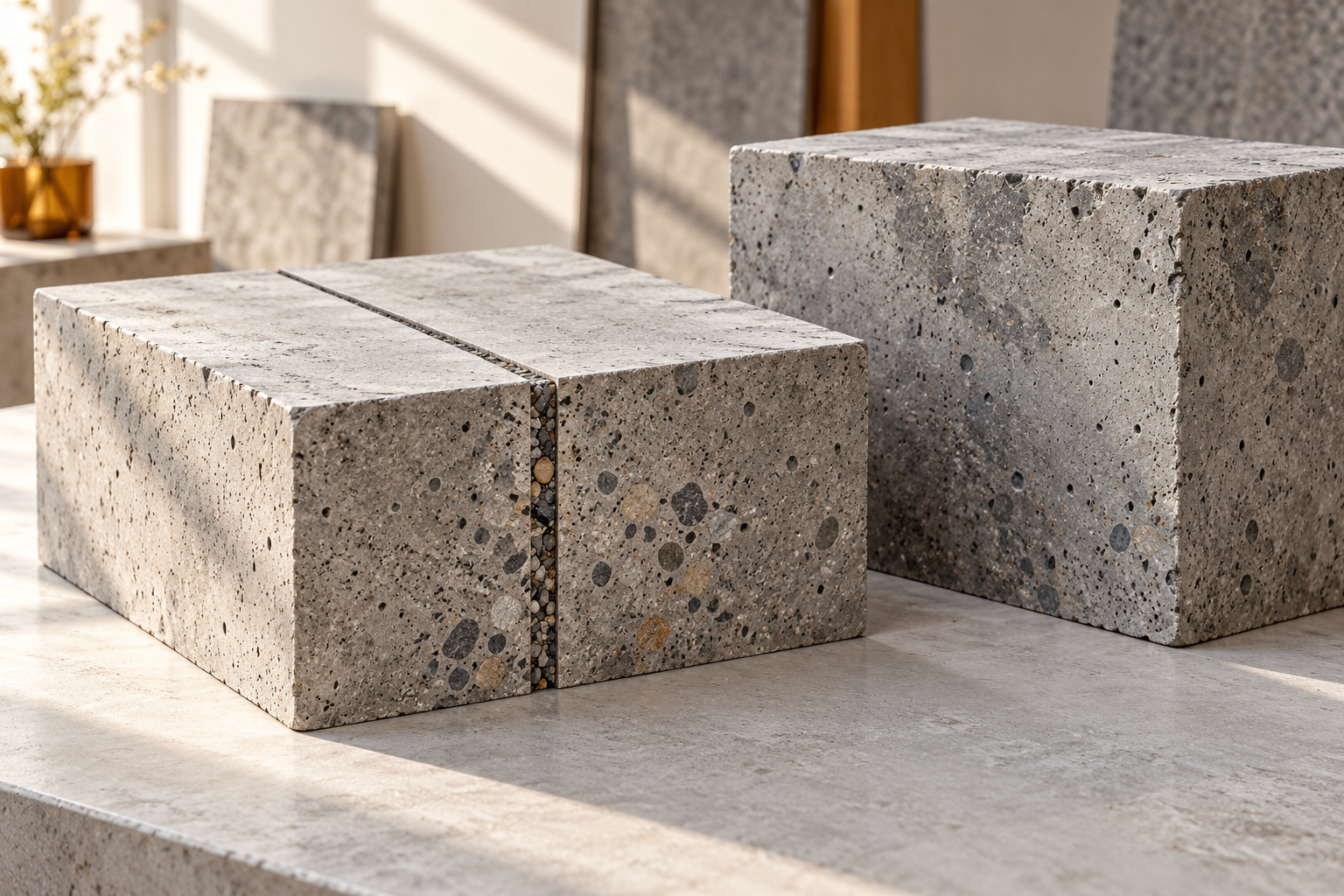
From across a room, concrete can look like one continuous grey material. A closer look at a cut face often reveals particles of different sizes surrounded by a finer matrix. Those visible constituents help explain why concrete is described as a composite. It combines materials into a body whose overall behaviour is not captured by the colour of its surface.
The word composite does not mean defective, improvised or unusual. It describes a material made from distinguishable constituents working together. In concrete, aggregate occupies space within a cementitious paste system. The finished material has an internal arrangement that a smooth external face can hide. A freshly revealed section and an old finished surface can therefore offer quite different visual information about the same body.
Cement and concrete name different things
Cement is a binder ingredient; concrete is the composite material made using a binder system and aggregate. Calling a slab cement in everyday conversation is common, but the words are not technically interchangeable. The distinction becomes useful when a discussion turns to what the material contains, how it developed or why its cut face looks heterogeneous.
The cementitious binder reacts with water through hydration. It is not simply loose dry powder filling the spaces between stones after a slab has hardened. The hydrated paste connects the material into a solid body. Explaining hydration as a reaction also avoids the misleading idea that concrete becomes hard solely because all its water has evaporated.
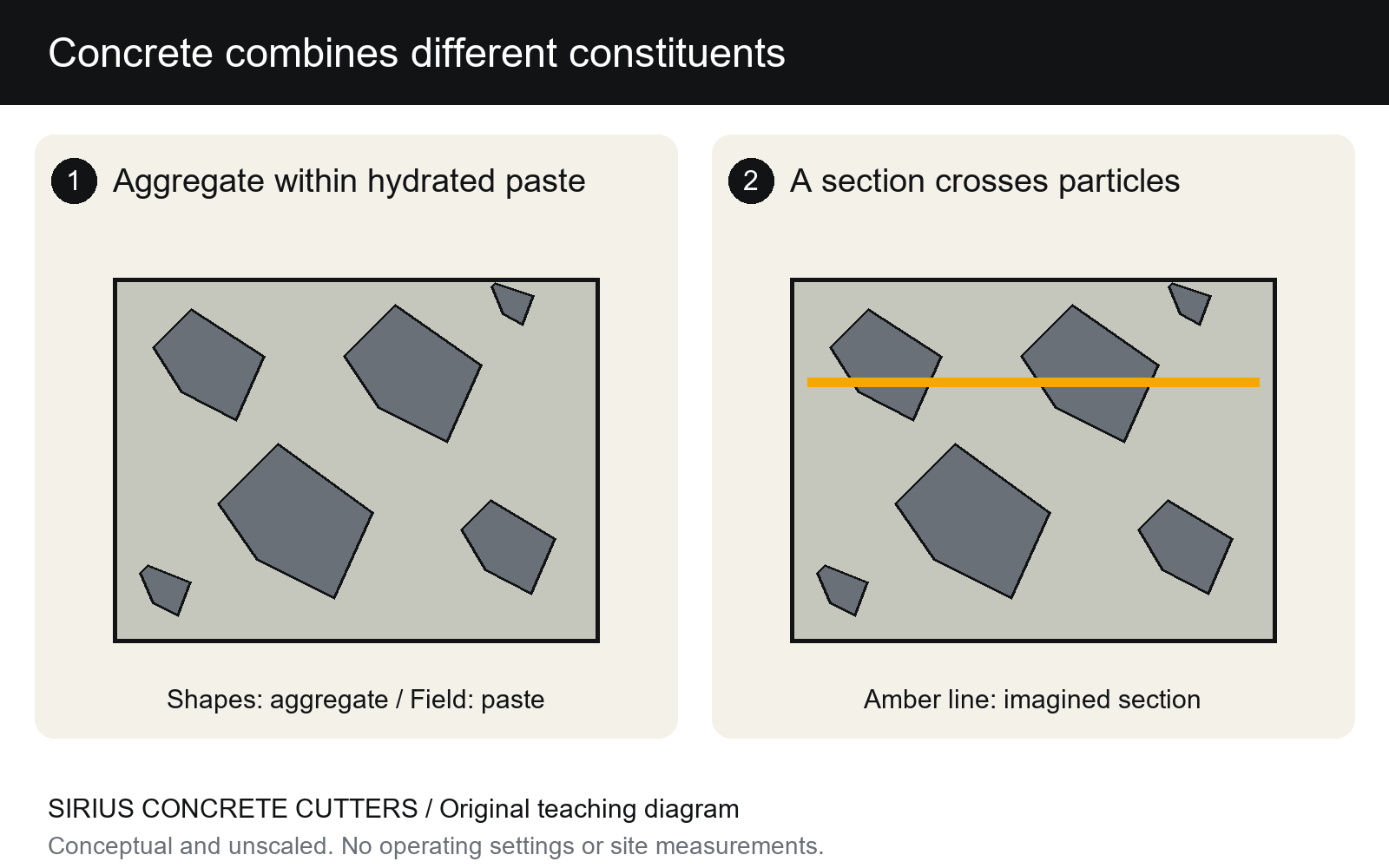
- 1. Aggregate particles sit within a hydrated cementitious paste system.
- 2. A section intersects different parts of particles, producing a local pattern rather than the complete three-dimensional arrangement.
Aggregate is not one uniform particle
Aggregate includes particles with a range of sizes and characteristics. A conceptual cross-section can show larger pieces together with smaller ones in the surrounding paste. The boundaries are useful for teaching because they identify different constituents. In a real material, the particular sizes, shapes, distribution and composition belong to the actual mix and cannot be inferred from this drawing.
Imagine slicing a fruit loaf. A section reveals pieces embedded in the surrounding body, while another slice reveals a different arrangement. The analogy illustrates why a section is a local view through a composite. Its purpose is to make the relationship between constituents and an exposed plane easier to picture.
One cut face is one plane through the material
A plane through a particle may cross its broad middle or only a small edge. The resulting shape on the cut face depends partly on where the plane intersects it. Two neighbouring sections through the same body need not expose identical patterns. The visible outline is therefore a section through a constituent, rather than a complete three-dimensional description of it.
A timely discussion about the binder
On 22 September 2026, the American Cement Association published technical guidance discussing blended cements and examples of their use. The dated discussion is relevant because it draws attention to the composition of the binder, which can also vary. Concrete should not be pictured as one unchanging recipe simply because two slabs share a familiar name.
Ingredients and outcomes remain different questions
Knowing that concrete contains aggregate and hydrated paste is a useful material description. It does not, by itself, establish its strength, age, reinforcement arrangement or suitability for a proposed alteration. Those are separate questions requiring evidence about the actual material and structure.
Likewise, a visible large particle does not supply a universal prediction of how an entire cut will proceed. The material system and actual work involve more than one observed feature. The point of the composite model is to improve understanding, not to rank slabs from a photograph or prescribe a tool on the basis of one visible stone.
Keep the surrounding details in view
A schematic drawing can use a uniform background to identify paste and a few distinct shapes to identify aggregate. Real concrete also contains other features, including pores and interfaces. Reinforcement may be present in a structure but is not the same constituent as aggregate. Omitting those features from a teaching diagram does not assert that an actual slab has none of them.
Why this matters when looking at a cut
A cut can reveal the inside of a body that previously presented only a finished surface. Recognising aggregate within hydrated paste helps explain the resulting pattern without treating every change in colour as the same thing. It encourages a more accurate question: which constituent or interface am I looking at, and what other evidence would be needed to interpret it?
Sirius’s current concrete cutting information provides the service setting for that curiosity. The general material lesson is useful before any discussion of a particular method: concrete is a composite, cement is one ingredient in its binder system, and a visible section is a local view through a varied interior. The name of the material is a starting description, rather than a complete specification.
Sources and further reading
Design and Control of Concrete Mixtures, 16th edition, chapter 1.
Sirius Concrete Cutters’ current service information.
Related reading: Why a diamond blade has a supporting core and a working rim and Kerf width, cut depth and blade diameter describe different things.
Sirius Concrete Cutters provides concrete cutting on the Gold Coast and in Brisbane. Get in touch to discuss your project.