

Summary
Construction diamond wire combines abrasive-bearing beads with a flexible supporting cable and other assembly components. The beads provide working contact while the cable connects and carries them through the moving assembly. A wire-saw diagram should distinguish those roles rather than depict a plain wire as the whole cutting tool.
For related work, see Sirius Concrete Cutters’ wire sawing service.
A thin line can hide several parts
A photograph of wire sawing can make the working tool look like one simple line. At a closer scale, construction diamond wire has a more structured appearance. Abrasive-bearing beads are arranged along a flexible supporting cable. Other components occupy the spaces between or around them, depending on the manufactured design. The line in a distant picture compresses those different parts into one shape.
The word wire therefore needs context. It can refer to the complete assembled cutting tool or to the cable inside that tool. Those are related meanings, but they do not identify exactly the same object. An explanation becomes clearer when it says whether it is describing the supporting cable, the abrasive beads or the complete assembly travelling through the system.
The supporting cable connects the assembly
The construction-industry catalogue from tool manufacturer Diabü includes a labelled wire diagram distinguishing the steel carrying wire, diamond beads and surrounding coating.
The drawing follows the general distinction. A continuous central line represents the support, while larger shapes identify bead positions. The line thickness and spacing make the parts easier to see.
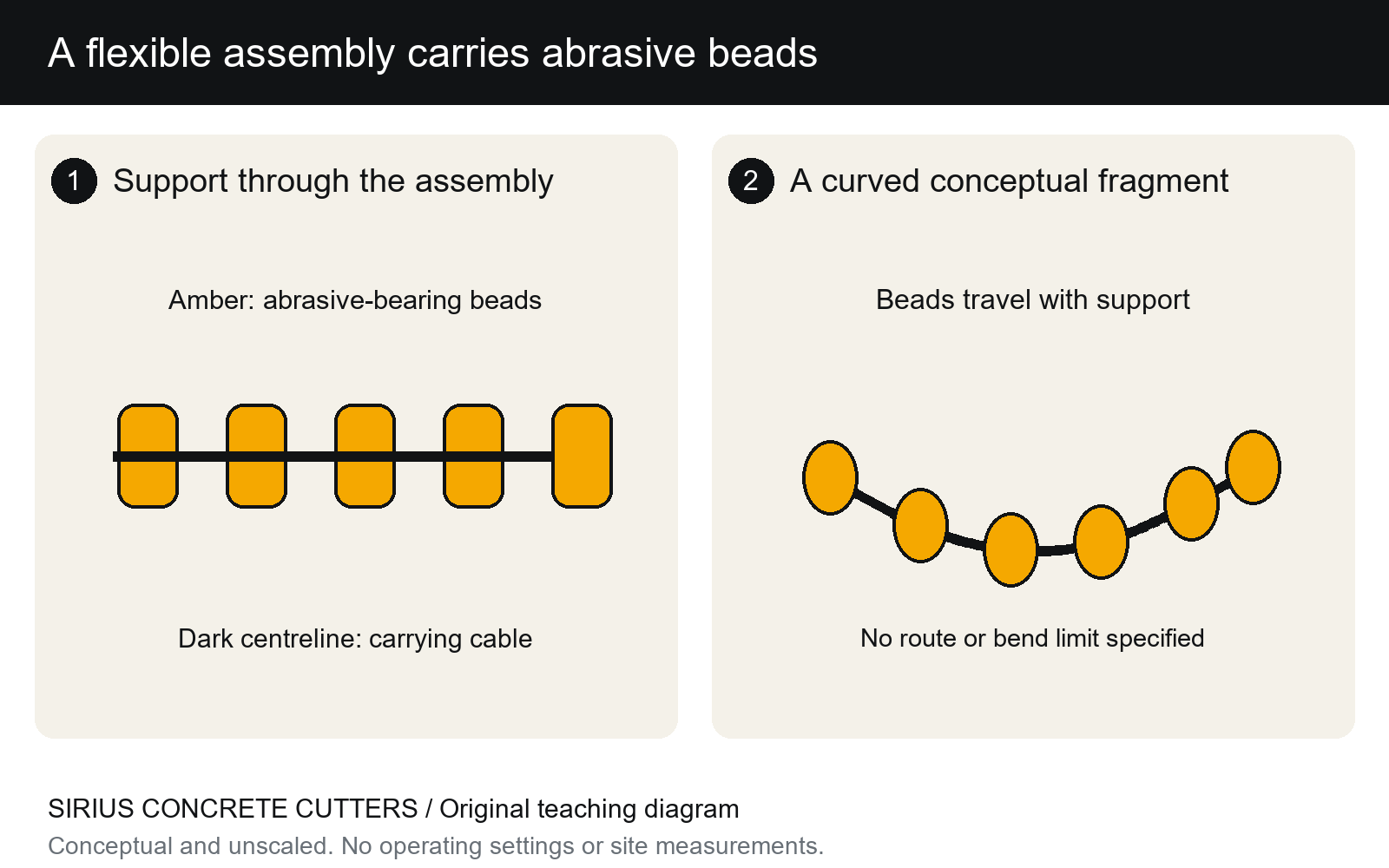
- 1. Abrasive-bearing beads occupy positions along a supporting cable; other manufactured assembly details are omitted.
- 2. A flexible assembly can follow a curved path while carrying distinct bead elements.
The bead carries abrasive at the contact
A bead is a manufactured working element around the support. Its abrasive-bearing surface interacts with the material being cut. The term diamond wire does not mean the entire flexible line is a solid thread of diamond. As with other abrasive tools, the working abrasive and its support occupy different positions and perform different functions in a combined tool.
It helps to imagine a string carrying separate objects as a purely visual analogy. The string connects the arrangement; the objects make the thicker visible portions. A cutting wire is an engineered assembly rather than household string. It simply prevents the supporting element and the carried elements being confused.
Flexibility and local contact coexist
A flexible supporting cable can follow a curved path even though the individual beads are distinct manufactured elements. Flexibility describes the response of the assembly over a length; it does not mean every component is soft or freely deformable. The overall path and the local working contact are different scales of the same mechanism.
The distinction is easier to see in a curved conceptual line. The centreline changes direction gradually, while the beads occupy successive positions along it. It shows why a moving flexible assembly need not be represented by one rigid circular blade in a teaching diagram.
Other components belong to a particular design
Husqvarna’s current wire overview describes assemblies using springs and rubber. Diabü’s catalogue also distinguishes surrounding material from the support and beads. These references illustrate that the spaces between visible abrasive elements are not necessarily empty.
Moving the support moves the beads
As the complete wire travels, the supporting structure carries the bead positions with it. The abrasive working surfaces therefore move through successive contact positions. That is a description of motion within the combined tool, not a calculation of cutting rate. Travel speed alone would not describe all the conditions at a real material contact.
A still image cannot show the full journey. It may show only one short section of the assembly. Arrows in a drawing can explain that movement exists.
Why a plain line is an incomplete model
Drawing only a single thin cable can imply that bare wire is the whole working surface. Drawing only a row of beads can hide what holds the assembly together. Each simplification may be useful for a particular question, but neither answers the construction question completely. A labelled diagram needs both the support and the abrasive-bearing elements to explain their relationship.
This is a broader lesson in reading technical pictures. What has been omitted may be as important as what is drawn. A schematic of a building service, material or tool is usually built to answer one question. Before using it for another question, check whether the necessary components and dimensions were ever represented in the first place.
Sirius’s current wire-sawing page explains that the proposed material, access and work arrangement need assessment. Knowing the names of beads and support does not establish a route, an anchoring arrangement or a method for releasing a section.
The physical idea remains useful on its own. A construction diamond wire is a combined abrasive tool whose visible line contains different roles. The supporting cable connects and carries; abrasive-bearing beads provide working contact; other manufactured components form part of the identified assembly. Seeing those roles separately gives a clearer picture of the tool.
Sources and further reading
Husqvarna’s diamond-wire overview: current manufacturer examples of bead assemblies with springs and rubber.
Diabü construction-industry catalogue, diamond-wire construction.
Sirius Concrete Cutters’ current service information.
Related reading: Why a diamond blade has a supporting core and a working rim and Why one full turn covers more distance at a larger radius.
Sirius Concrete Cutters provides wire sawing on the Gold Coast and in Brisbane. Get in touch to discuss your project.